
← Selected work

Project / 04

MetalMind

Run local LLMs on your Mac. A zero-overhead, 100% native macOS app for Apple Silicon local AI — built on Apple MLX, with a local OpenAI-compatible API server. Since version 1.1 the model can also act on what you hand it, always behind an explicit approval.

  • macOS 26+ (Apple Silicon)
  • Zero-RAM Idle
  • Local API Server
  • Workspace & Agent Tools
Role
Sole developer — engine, app, server, site
Platform
macOS 26+ · Apple Silicon
Engine
Apple MLX · Metal · Swift
Surface
SwiftUI app · OpenAI-compatible API · App Intents
Shipped
Mac App Store · v1.1
MetalMind — Apple Silicon Local Engine
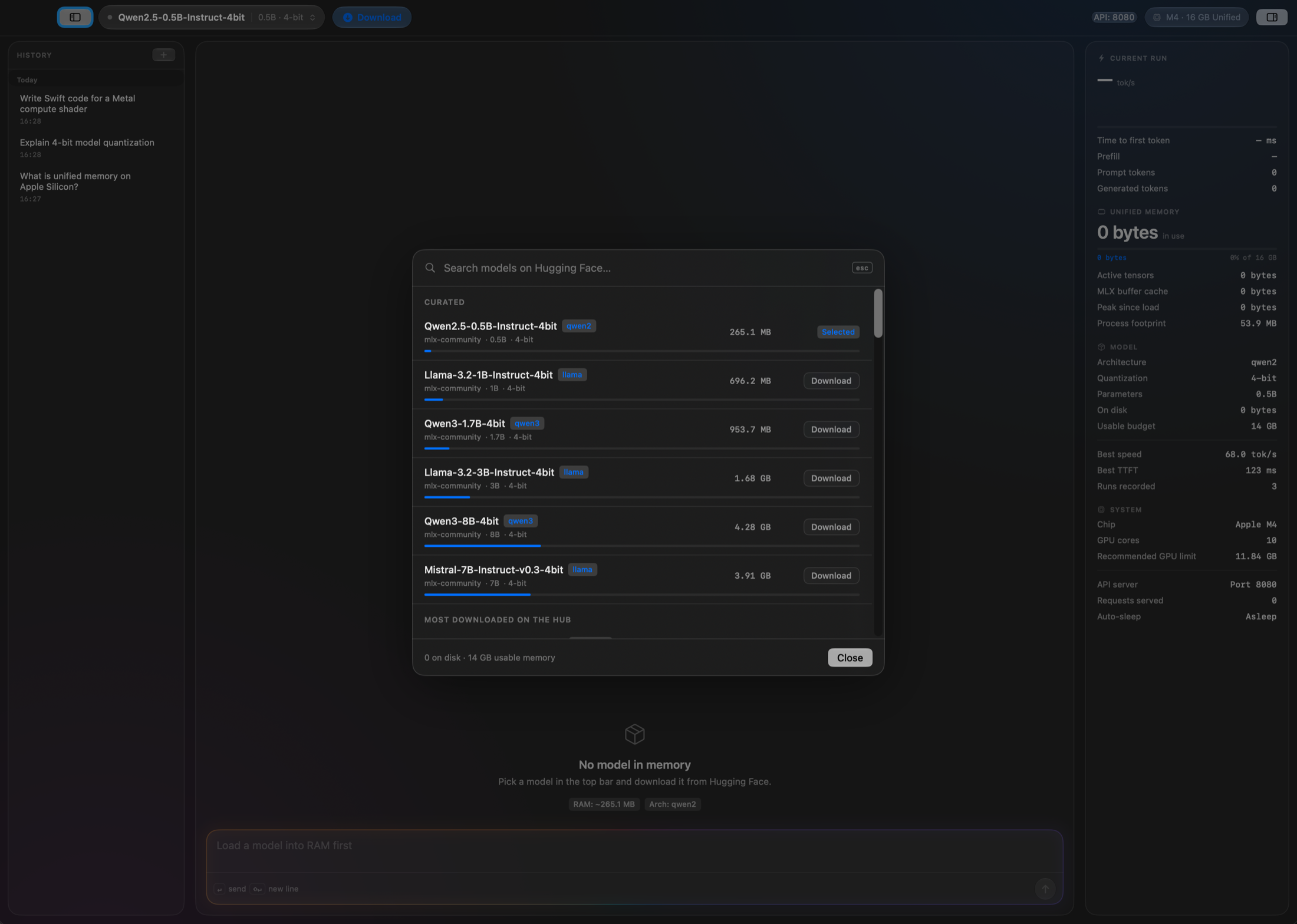
MetalMind running on macOS: model browser, chat history, and live unified memory telemetry
68.0 tok/s · M4 · 16 GB · Qwen2.5-0.5B 4-bit

01 / Decisions

Four decisions the whole product rests on.

Runtime

Apple MLX, not a bundled runtime

MLX Swift links in as a package and runs in the same process as the app: no subprocess to supervise, no bridging layer, one memory model instead of two. It also hands over the GPU buffer cache — which is the only reason eviction is possible at all. Shipping someone else’s inference binary would have meant updating it on their schedule and giving that control up.

Memory

Eviction is a state, not a setting

Dropping the tensors does not return the memory: MLX recycles buffers, and only an explicit clearCache() hands them back. So the engine caps the reserve at 32 MB at launch, counts down an idle timer, then cancels the run, releases the container, clears the cache and resets the peak. Five minutes of silence and a loaded model costs nothing.

Local API

A hand-written server on Network.framework

An NWListener and a request parser, not a framework — no dependency to audit in an app whose whole claim is that nothing leaves the Mac. Unknown fields are ignored rather than rejected, so a client written against OpenAI keeps working. Structured output refuses to stream: a shape can only be enforced once the whole reply exists, and bytes already sent cannot be taken back.

Agent loop

Approval as a constraint, not a toggle

Tool calls return proposals, not results. A file edit becomes a diff with just enough context around it that a one-line fix in a long file stays a short preview; calendar entries and shortcut runs become permission cards. The model is never asked to confirm first — the card is the confirmation, and asking twice only teaches people to click through. There is no autonomous mode to enable, because there is no switch.

02 / Build notes

Three things that took longer than they look.

  1. Reasoning models bury the answer

    Qwen3 and its kind wrap their chain of thought in <think> tags. The transcript folds that away rather than stripping it — it is still what the model produced, so it stays in the text.

  2. Chat templates disagree across architectures

    Tool support cannot be read off a model name or a Hub tag. The template on disk is the ground truth, and it is parsed to decide whether this model can be offered tools at all.

  3. A paywall the model must not route around

    Pro-only tools answer on the free tier with an explanation instead of a result, and the system prompt tells the model not to work around the gate — otherwise it tries another tool to get the same effect.

03 / Questions

The parts worth explaining.

Why Apple MLX instead of llama.cpp or Ollama?

MLX Swift links into the app and runs in-process on unified memory: no subprocess to supervise, no bridging layer, one memory model. It also exposes the GPU buffer cache, which is what the idle eviction depends on. A bundled inference binary would have meant shipping and updating someone else’s release, and giving up that control.

How is the idle eviction actually implemented?

MLX recycles buffers, so releasing tensors returns nothing to the system. The engine caps the recycled reserve at 32 MB at start-up and, when the idle countdown runs out, cancels any generation in flight, drops the model container, calls clearCache() and resets the peak counter. The next prompt pays for one model load.

How does the app know a model can use tools?

From its chat template, never from its name. There is no reliable tag for it on the Hub, and the template is the ground truth: one that never reads the tool list drops it silently — the model is offered nothing, gets asked for a file, and invents one. So the template is read from disk and judged.

Why write the HTTP server by hand?

Because the surface that matters is small: one endpoint shape, SSE framing, and tolerant parsing. A server framework would have added a dependency and its transitive tree to an app that promises nothing leaves the machine.

How do you test something built on a non-deterministic model?

By testing the seams, not the output. The test suite covers the parts with one right answer — template capability detection, tool-call parsing, the diff builder, the generation queue, structured-output validation, request handling, purchase gating. The model’s prose is never asserted on; that would only test the sampler.

04 / Benchmarks

Measured on device, not extrapolated.

Performance Telemetry (Apple Silicon M-Series)

Sustained decode throughput on an Apple M4 with 10 GPU cores and 16 GB of unified memory, running Qwen2.5-0.5B-Instruct in 4-bit, measured end to end through the MLX Swift graph.

Zero-setup API call
curl http://localhost:8080/v1/chat/completions \
  -H "Content-Type: application/json" \
  -d '{
    "model": "qwen2.5-0.5b",
    "messages": [{"role": "user", "content": "Explain unified memory."}],
    "stream": true
  }'

A local model that behaves like a native app — and can now act like one.

MT/DEV

Czech Republic · Working remotely

© 2026 Martin Turek